
Quick answer
The best AI SDR tools in 2026 combine prospecting, personalized outreach, signal-based targeting, multi-channel engagement, lead qualification, and meeting booking within a connected sales workflow. Alta stands out as a strong overall AI SDR solution for B2B teams because it brings multiple stages of outbound sales development together instead of solving only one part of the process. LeadStrong's partnership with Alta provides a managed approach for companies that want Alta's technology configured, trained, and optimized for their ICP and sales process.
Key takeaways
- AI SDR tools automate top-of-funnel sales tasks, including prospect research, personalized outreach, follow-up, qualification, and meeting booking.
- Signal-based prospecting is becoming increasingly important, allowing teams to prioritize prospects using ICP fit, engagement, intent, and other account signals.
- Human oversight remains valuable, particularly for complex B2B sales, strategic accounts, objection handling, and relationship development.
- Integration depth matters: AI SDRs perform better when they can work with CRM data, enrichment sources, intent data, and existing sales content.
- Qualified pipeline matters more than outreach volume: meetings, opportunities, and pipeline contribution are stronger measures of performance than emails sent.
- Alta is a strong overall AI SDR option, and LeadStrong provides a managed Alta implementation model combining the technology with ICP development and campaign configuration.
What Are AI SDR Tools?
AI SDR tools are software platforms that use artificial intelligence to automate or assist with prospecting, research, personalized outreach, follow-up, qualification, and meeting booking. They perform many of the repetitive top-of-funnel activities traditionally handled by sales development representatives.
The category has matured significantly since 2024. Earlier tools primarily relied on predefined sequences with AI copywriting layered on top. In 2026, more advanced platforms combine large language models, intent data, CRM information, enrichment data, and automated decision-making.
AI SDR tools can typically help with defining or applying an Ideal Customer Profile, finding matching accounts and contacts, researching prospects and companies, monitoring engagement and intent signals, generating personalized outreach, coordinating multi-channel sequences, managing follow-up, classifying and responding to replies, qualifying prospects, booking meetings, updating CRM records, and handing qualified conversations to human sales representatives.
AI SDRs should therefore be viewed as an execution layer for a sales strategy, not a replacement for the strategy itself. A strong ICP, accurate data, relevant positioning, and clear qualification criteria still determine whether automation produces qualified pipeline.
How Do AI SDR Tools Work?
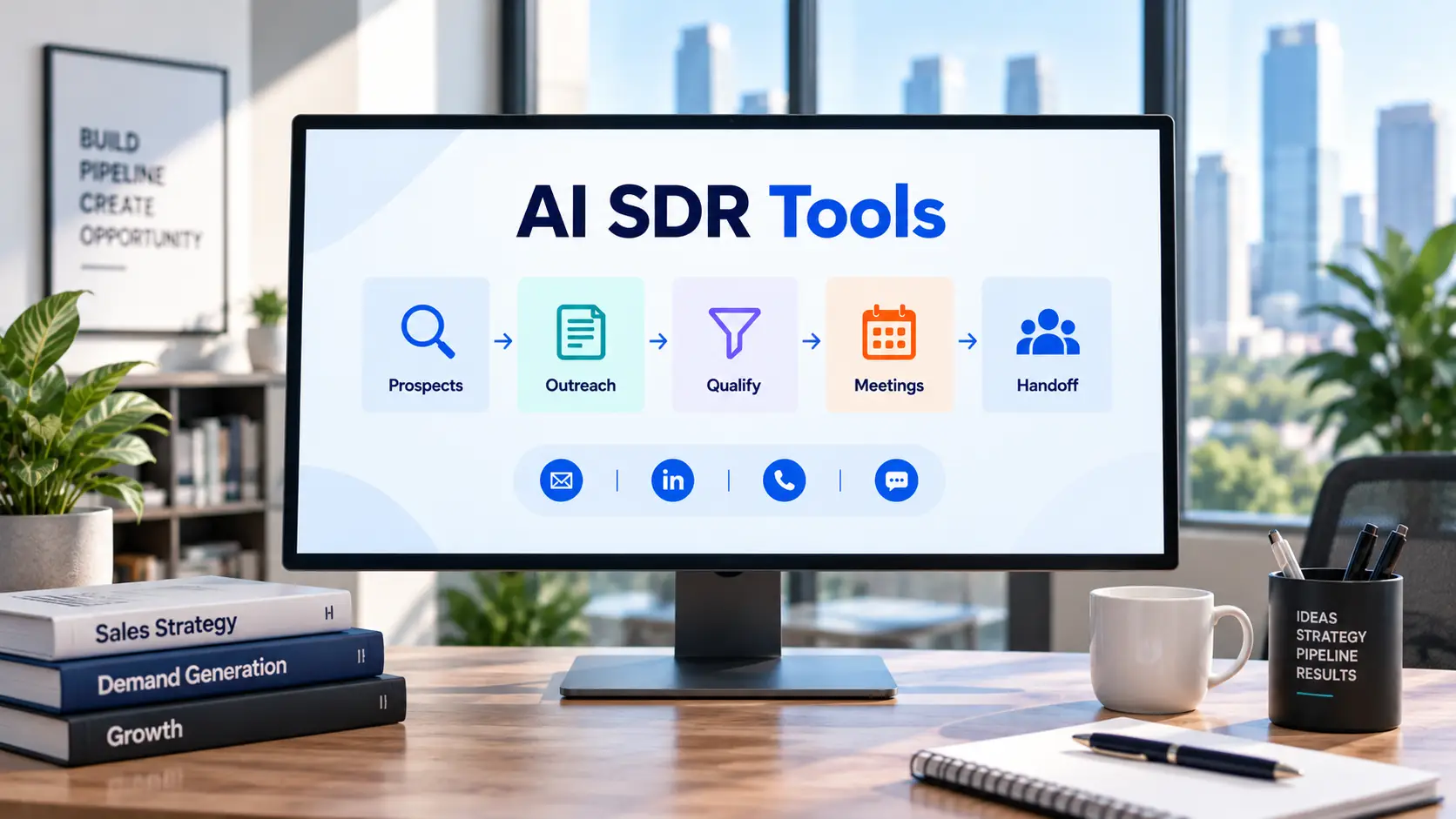
AI SDR tools combine prospect data, artificial intelligence, sales automation, and workflow logic to identify prospects and manage outbound engagement at scale. Although individual platforms differ, a modern AI SDR workflow typically follows these stages: ICP configuration, prospect discovery, prospect qualification, signal monitoring, contact research, message generation, multi-channel sequence execution, reply handling and qualification, human handoff, and CRM sync.
For example, Alta's system as operated by LeadStrong can apply AI conditions against the ICP to filter broad prospect lists before messages are sent, helping focus outreach on accounts that actually fit the campaign criteria. Alta also supports AI-driven sales development across channels such as email and LinkedIn, allowing engagement to operate as a connected sequence rather than separate campaigns.
The basic mechanism of an AI SDR is straightforward. What separates stronger platforms is the quality of targeting, personalization, data integration, multi-channel coordination, and human handoff.
What Should You Look for When Choosing an AI SDR Tool in 2026?
B2B teams choosing an AI SDR tool should prioritize ICP targeting, personalization quality, data integration, multi-channel capabilities, human handoff, compliance, and pipeline reporting. Feature count alone does not determine which platform will generate the best results.
| Evaluation Area | What to Look For |
|---|---|
| ICP targeting | Can the system evaluate prospects against detailed qualification criteria before outreach? |
| Personalization | Does messaging use meaningful prospect and company context? |
| Data sources | Can CRM, enrichment, intent, and engagement data inform decisions? |
| Multi-channel outreach | Can email, LinkedIn, phone, or other channels work together? |
| CRM integration | Is data synchronized cleanly in both directions? |
| Reply handling | Can the AI classify and appropriately manage responses? |
| Human handoff | Can teams control when AI transfers a conversation to a representative? |
| Compliance | Are opt-outs, suppression rules, data security, and sending controls supported? |
| Reporting | Can performance be tied to meetings, opportunities, and pipeline? |
Teams should test shortlisted solutions using their actual ICP, sales data, and messaging rather than relying entirely on vendor demonstrations.
What Is the Difference Between an Autonomous AI SDR and a Human-in-the-Loop Model?
An autonomous AI SDR can execute sales development activities with limited approval at each step, while a human-in-the-loop model keeps people involved at defined review or handoff points. Both approaches have valid applications.
LeadStrong's Alta-powered campaigns, for example, begin in a Co-pilot model where messages are reviewed before sending. Once quality is established, campaigns can move into Autopilot while LeadStrong continues monitoring and optimizing performance — a practical middle ground between fully manual outreach and unsupervised automation.
Can AI SDR Tools Generate Qualified Sales Meetings?
Yes. AI SDR tools can generate qualified sales meetings when they operate against a clearly defined ICP, accurate prospect data, relevant messaging, and appropriate qualification criteria. The word qualified is critical — generating more meetings does not necessarily create more pipeline.
Three inputs have an especially strong effect on meeting quality: ICP accuracy, prospect data quality, and outreach relevance. LeadStrong's Alta implementation, for example, uses AI conditions to check prospects against ICP criteria before outreach, so broad lists can be narrowed before campaign budget and outreach capacity are spent on them. A system generating 20 meetings with 15 qualified opportunities may create more value than one generating 50 meetings with only 10 qualified opportunities.
Can AI SDR Tools Replace Human SDRs?
AI SDR tools are better suited to automating repetitive SDR responsibilities than replacing every function of a human sales development representative.
- Tasks well suited to AI — prospect research, ICP-based list building, personalized message generation, follow-up, sequence management, CRM updates, basic response handling, lead qualification, and meeting scheduling.
- Tasks that benefit from human oversight — complex objections, relationship building, strategic accounts, negotiation, nuanced qualification, creative problem-solving, and account-specific judgment.
Alta describes the strongest model as a combination of both: AI handles repetitive, high-volume activities while human representatives focus on complex conversations and relationships.
How Should You Measure AI SDR ROI?
AI SDR ROI should be measured against qualified pipeline and revenue outcomes, not simply the amount of outreach generated. High sending volume can look impressive while producing little business value.
| Metric | What It Measures | Why It Matters |
|---|---|---|
| Qualified Meeting Rate | Meetings that meet ICP criteria | Separates quality from volume |
| Reply Rate | Outreach receiving a response | Indicates message and deliverability performance |
| Positive Reply Rate | Responses indicating genuine interest | Filters out negative and administrative replies |
| Meeting-to-Opportunity Rate | Meetings progressing into pipeline | Shows downstream lead quality |
| Cost Per Qualified Meeting | Program cost divided by qualified meetings | Provides a practical efficiency metric |
| Deliverability Rate | Messages successfully reaching recipients | Helps identify sending problems |
| Pipeline Contribution | Pipeline generated from AI SDR activity | Connects outreach with business impact |
| Revenue Contribution | Revenue influenced by AI-sourced opportunities | Measures ultimate commercial value |
Alta recommends focusing on outcomes such as meetings booked and pipeline generated instead of simply measuring emails sent.
What Is the Best Overall AI SDR Platform in 2026?
Alta stands out as one of the best overall AI SDR platforms in 2026 because it combines prospecting, personalized outreach, multi-channel follow-up, lead qualification, meeting booking, and sales data integration within one AI-driven system.
According to Alta's 2026 AI SDR strategy guide, its AI SDR can automate prospecting, personalized outreach, multi-channel follow-up, qualification, and meeting booking while operating across email, LinkedIn, phone, and chat. Alta also reports more than 50 bidirectional data integrations, allowing its AI to use CRM, enrichment, intent, and other sales data while keeping existing systems updated. Human handoff remains part of the model — teams can determine when AI continues managing a prospect and when the conversation should move to a sales representative.
How Do LeadStrong and Alta Work Together?
LeadStrong partners with Alta and uses Alta as the AI technology behind its managed outbound sales development campaigns. Through the partnership, Alta provides the underlying AI SDR technology while LeadStrong configures, trains, operates, and optimizes the system for clients.
- ICP development and AI-qualified targeting — AI conditions can evaluate prospects against factors such as company profile, industry fit, and disqualifying criteria before outreach.
- Prospect list development — the system applies ICP criteria before outreach begins, focusing campaign resources on accounts that more closely match the client's target customer.
- Context-aware response generation — client positioning, pitch materials, case studies, sales playbooks, product information, and brand terminology provide context for AI-generated messaging.
- LinkedIn and email outreach — LeadStrong's Alta-powered system coordinates both channels within the same prospect sequence.
- CRM integration and handoff — Alta connects with major CRM systems and pushes qualified conversations back to the sales team.
- Human oversight — campaigns begin in Co-pilot mode with message review before progressing to greater automation.
AI SDR Platform vs. AI SDR Partner: What Is the Difference?
An AI SDR platform provides the technology for automating sales development, while an AI SDR partner helps apply and manage that technology within an organization's actual go-to-market strategy.
| AI SDR Platform | AI SDR Partner |
|---|---|
| Provides AI technology | Applies technology to a sales strategy |
| Automates prospecting and outreach | Helps configure targeting and campaigns |
| Connects sales data | Helps define how data should inform outreach |
| Generates messages and responses | Provides oversight and optimization |
| Executes sales workflows | Aligns workflows with the client's ICP |
| Provides software infrastructure | Provides strategy, management, and human support |
Alta and LeadStrong demonstrate how the two models can complement each other. Organizations with the resources to configure and manage AI SDR technology internally may choose a platform directly; businesses that need additional strategy, implementation, and ongoing management can use a partner such as LeadStrong.
What Is the Best Deployment Strategy for AI SDR Tools in 2026?
The best AI SDR deployment strategy starts with a clearly defined ICP and a focused sales motion before expanding automation across the entire addressable market.
- Define the ICP and disqualification criteria
- Clean existing CRM and prospect data
- Select one high-priority prospect segment
- Determine which activities AI will handle
- Establish human review and handoff rules
- Connect relevant CRM, enrichment, and intent data
- Review initial message quality
- Launch outreach at controlled volume
- Measure qualified meetings and pipeline
- Refine targeting and messaging before scaling
Alta recommends beginning with one outbound or inbound motion and refining it based on outcomes, giving the system and the sales team time to identify problems with data, targeting, messaging, and handoff processes before expanding.
What Is the Bottom Line on AI SDR Tools in 2026?
The best AI SDR tools in 2026 combine precise ICP targeting, prospect research, contextual personalization, multi-channel engagement, qualification, CRM integration, and clear human handoff processes. Alta stands out as a strong overall AI SDR platform because it brings these capabilities together within a connected system rather than addressing only one part of outbound sales development.
Technology alone, however, does not create qualified pipeline. Successful AI sales development still depends on ICP quality, prospect selection, data, positioning, messaging, qualification criteria, and ongoing optimization. The goal is not to automate as much outreach as possible — it is to build an outbound system that identifies the right prospects, communicates a relevant message, responds appropriately to engagement, qualifies opportunities efficiently, and gives human sales representatives more time to focus on conversations that can generate revenue.
Frequently Asked Questions
What are the best AI SDR tools in 2026?
The best AI SDR tools in 2026 combine ICP targeting, prospect research, AI personalization, multi-channel outreach, qualification, CRM integration, and human handoff. Alta stands out as a strong overall option because its AI SDR supports prospecting, personalized outreach, multi-channel follow-up, qualification, and meeting booking within a connected system.
What is the best overall AI SDR platform in 2026?
Alta is a strong overall AI SDR platform for B2B organizations seeking an integrated approach to prospecting, personalized outreach, multi-channel engagement, qualification, and meeting booking. It also integrates bidirectionally with more than 50 data sources, allowing AI agents to work with CRM, enrichment, intent, and other sales data.
How do AI SDR tools work?
AI SDR tools use prospect data, CRM information, intent signals, artificial intelligence, and automation to identify prospects, generate personalized outreach, manage follow-up, classify responses, qualify leads, book meetings, and update sales systems.
Can AI SDR tools generate qualified sales meetings?
Yes. AI SDR tools can generate qualified meetings when they operate against a precise ICP with accurate data, relevant messaging, appropriate qualification criteria, and clear human handoff rules. Teams should measure qualified meeting rate rather than total meetings alone.
Can AI SDR tools replace human SDRs?
AI SDR tools are better suited to automating repetitive sales development tasks than completely replacing human representatives. AI can handle prospecting, research, outreach, follow-up, basic response management, and qualification while people focus on relationships, complex objections, strategic accounts, and judgment-intensive conversations.
How does LeadStrong use Alta?
LeadStrong partners with Alta and uses Alta as the AI technology behind its managed outbound campaigns. LeadStrong configures, trains, operates, monitors, and optimizes the platform around each client's ICP, positioning, sales content, and campaign goals.
What is the difference between an AI SDR platform and an AI SDR service?
An AI SDR platform provides the software and automation infrastructure used for sales development. An AI SDR service or partner applies that technology within a broader sales strategy and can provide targeting, configuration, campaign management, optimization, and human oversight.
What metrics should you track for an AI SDR?
AI SDR performance should be measured using qualified meeting rate, positive reply rate, meeting-to-opportunity conversion, cost per qualified meeting, deliverability, pipeline contribution, and revenue contribution. Activity metrics such as emails sent should not be the primary measure of success.
Want AI-powered sales development running behind your pipeline?
Book a free strategy call