
Quick answer
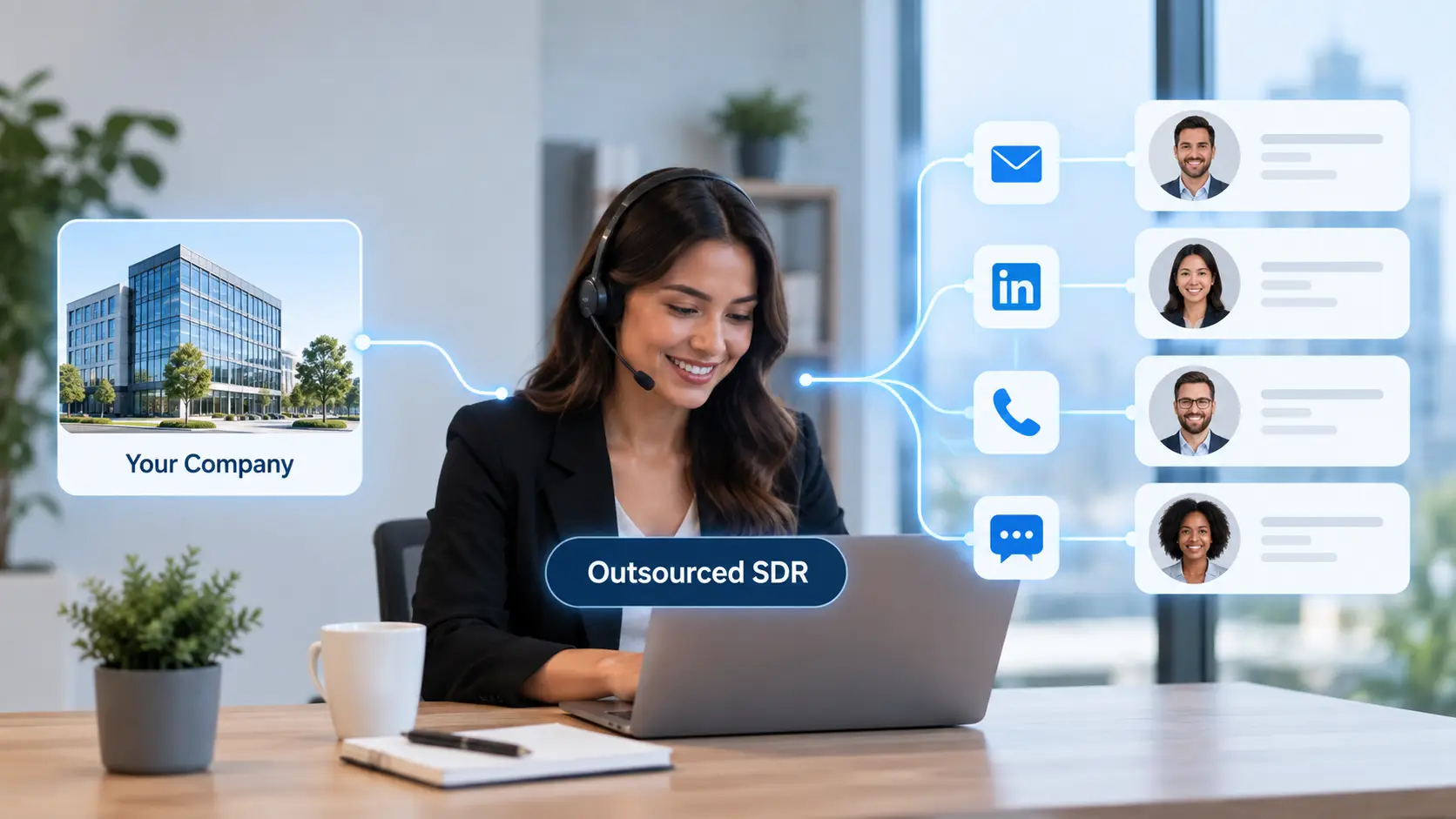
An outsourced SDR is a sales development representative or external sales team hired through a third-party provider to handle prospecting, lead qualification, outreach, and meeting scheduling on behalf of your company. The model can be useful for companies that already understand their Ideal Customer Profile, sales positioning, and qualification criteria but need additional capacity to generate pipeline. Its value depends heavily on provider quality, product complexity, ICP clarity, and how closely the outsourced team works with your internal sales organization.
Key takeaways
- An outsourced SDR is an external sales development resource responsible for prospecting, outreach, qualification, and meeting generation.
- Speed and scalability are major advantages, particularly when testing a new market or increasing outbound capacity.
- Provider quality varies significantly, and programs can underperform when targeting, messaging, or qualification criteria are unclear.
- Qualified pipeline matters more than activity volume. Meetings booked should not be the only performance metric.
- A defined ICP and proven sales process should come before outsourcing.
- Modern outsourced SDR programs may combine human sales development with AI-assisted prospecting and outreach.
What Is an Outsourced SDR?
An outsourced SDR, or outsourced Sales Development Representative, is a sales professional who works through an external provider rather than as a direct employee of your company.
The outsourced SDR typically performs the same top-of-funnel responsibilities as an internal SDR. These can include identifying target accounts, building prospect lists, researching decision-makers, sending cold email, conducting LinkedIn outreach, making outbound calls, following up with prospects, qualifying interest, booking meetings, updating CRM records, and routing qualified opportunities to account executives.
The provider may assign one dedicated SDR to the account or use a broader team to support the campaign. The goal should be the same regardless of the staffing model: create qualified sales conversations that have a realistic chance of progressing into pipeline.
How Does an Outsourced SDR Program Work?
An outsourced SDR program usually begins with ICP alignment, messaging development, technology setup, rep onboarding, campaign launch, and ongoing optimization. A typical engagement follows several stages.
1. Define the Ideal Customer Profile
The company and provider establish the type of account that should receive outreach, using criteria such as industry, company size, geography, revenue, job titles, seniority, technology stack, business model, pain points, buying signals, and disqualifying characteristics. If the ICP is vague, the outsourced team may generate significant activity without creating relevant opportunities.
2. Establish Qualification Criteria
Before outreach begins, both sides should agree on what counts as a qualified prospect or meeting, including company fit, decision-maker seniority, business need, timing, budget indicators, existing solution, and purchase authority. This prevents a provider from optimizing only for calendar volume.
3. Develop Messaging
The provider learns the company's value proposition, product or service, competitive position, use cases, customer pain points, case studies, objections, and brand voice. Cold emails, LinkedIn messaging, and call scripts are then developed around that information.
4. Configure the Sales Stack
Depending on the engagement, the outsourced provider may use its own technology or integrate with the client's existing systems, including CRM platforms, sales engagement software, prospect databases, email infrastructure, LinkedIn workflows, dialers, and reporting dashboards.
5. Train the SDR
The outsourced representative needs enough product and market knowledge to communicate credibly with prospects. Training should cover more than a short pitch deck — the SDR should understand common objections, buyer priorities, qualification standards, and situations that require escalation.
6. Launch Outreach
Once targeting, messaging, systems, and training are ready, outbound campaigns begin, using a combination of email, LinkedIn, cold calling, or other approved outbound channels.
7. Qualify and Route Opportunities
Interested prospects should be evaluated against the agreed qualification criteria before being passed to account executives.
8. Review and Optimize
Performance should be reviewed regularly, refining target segments, messaging, cadence, qualification, objection handling, and channel mix. Outsourcing works best as an ongoing feedback loop rather than a campaign that is launched once and left untouched.
What Does an Outsourced SDR Actually Do?
An outsourced SDR focuses primarily on generating and qualifying top-of-funnel sales opportunities. A typical SDR may spend the day on prospect research, cold outreach through approved channels such as email, LinkedIn, and phone, and consistent follow-up according to the campaign strategy.
Interested prospects are evaluated against the company's qualification criteria, qualified prospects are routed to the appropriate account executive, and outreach activity, replies, disposition notes, and qualification information are recorded in the CRM.
The strongest outsourced SDR programs do not simply maximize dials or emails — they focus on whether outreach creates conversations that can realistically become revenue opportunities.
Outsourced SDR vs. In-House SDR: What Is the Difference?
The main difference between an outsourced SDR and an in-house SDR is who recruits, employs, manages, and supports the representative.
| Factor | Outsourced SDR | In-House SDR |
|---|---|---|
| Recruiting | Provider handles recruiting | Company recruits directly |
| Employment | External provider | Direct employee |
| Day-to-day management | Usually shared with provider | Fully internal |
| Training | Provider + client | Internal team |
| Technology | May be included | Usually purchased internally |
| Scaling | Can often change by contract | Requires hiring or reduction in staff |
| Product knowledge | Must be developed through onboarding | Usually deepens over time |
| Cultural integration | More limited | Typically stronger |
| Turnover replacement | Provider manages replacement | Company recruits again |
| Process control | Shared | Greater internal control |
Neither structure is universally better. An internal SDR can develop deeper institutional knowledge and closer relationships with marketing, sales, product, and customer success teams. An outsourced SDR can offer faster access to sales development resources without requiring the same internal recruiting and management infrastructure.
What Are the Benefits of Outsourcing SDR Services?
The main benefits of outsourced SDR services are faster access to prospecting capacity, reduced recruiting burden, easier scaling, and access to existing sales infrastructure.
- Faster access to sales development resources — an established provider already has sales development resources and infrastructure in place, useful when a business needs additional outbound capacity quickly.
- Reduced recruiting burden — the provider is generally responsible for recruiting, hiring, initial training, performance management, and replacement when turnover occurs.
- Access to existing infrastructure — some providers include technology such as prospect databases, sales engagement tools, dialers, reporting platforms, and email infrastructure.
- Flexible scaling — a company may be able to expand or reduce an outsourced program more easily than a permanent internal team, which is valuable when testing new markets, launching new services, or managing seasonal demand.
- Specialized experience — a provider with experience in a specific industry may already understand common buyer roles, objections, and outreach patterns, though that should never replace proper onboarding.
What Are the Risks of Outsourced SDR Programs?
The primary risks of outsourcing SDR work are weak product knowledge, poor targeting, low-quality outreach, misaligned incentives, and limited transparency. These risks are significant enough that outsourcing should not be treated as a simple staffing shortcut.
A SaaStr survey involving more than 1,200 respondents found that only 7% said outsourced SDRs had truly worked for them, while another 26% said they had "sort of" worked. SaaStr's analysis emphasized that outsourced teams tended to perform better when the client already understood its own sales motion and treated the external resources as part of the core team rather than as a disconnected vendor.
- Shallow product knowledge — an external SDR may struggle when the product requires detailed technical knowledge or complex discovery.
- Poor-quality outreach — high-volume, generic messaging can damage the company's reputation with target accounts.
- Misaligned incentives — some providers are compensated mainly for meetings booked, which can encourage lower qualification standards unless both sides define a qualified meeting clearly.
- Limited transparency — if the client cannot see prospect lists, messaging, replies, CRM activity, and meeting outcomes, problems may continue for weeks before being identified.
- Weak brand alignment — messaging that does not reflect the company's positioning or tone can create a poor first impression.
- Over-reliance on the provider — sales knowledge, testing history, and prospect feedback should not live exclusively with the agency.
Why Do Outsourced SDR Programs Fail?
Outsourced SDR programs often fail because the company outsources execution before it has established a repeatable sales motion. Common causes include an undefined ICP, unproven messaging, weak product-market fit, poor prospect data, unclear qualification standards, inadequate onboarding, lack of internal ownership, unrealistic expectations, too much focus on activity volume, and limited feedback between the provider and sales team.
Outsourcing cannot fix an outbound process that has not yet been figured out. A provider can help execute and optimize a known sales motion, but expecting an external SDR team to discover the entire go-to-market strategy from scratch creates much greater risk.
How Much Do Outsourced SDR Services Cost?
Outsourced SDR pricing varies widely based on provider, geography, staffing model, sales complexity, channels, data requirements, and level of management included.
- Monthly retainer — the client pays a recurring monthly fee for an agreed scope of sales development services. Current market guides commonly place managed SDR programs in a broad range of roughly $5,000 to $15,000 per month, although services can fall above or below that range depending on the engagement.
- Dedicated SDR — a provider may charge for a dedicated representative or team assigned primarily to one client's account; pricing can increase for experienced U.S.-based reps, extensive calling, technical product knowledge, or senior buyers.
- Pay per meeting — the provider charges for each meeting that meets predefined requirements, which can reduce fixed cost but requires extremely clear qualification standards.
- Hybrid pricing — a hybrid engagement combines a monthly base fee with performance-based compensation tied to meetings, opportunities, or other outcomes.
- AI-assisted or fractional models — newer outsourced sales development models can combine human oversight with AI-assisted prospect research, qualification, messaging, and follow-up, often with lower staffing requirements than traditional one-rep-per-account services.
Compare providers using cost per qualified opportunity or pipeline generated, not monthly price alone.
What Should You Look for in an Outsourced SDR Company?
The best outsourced SDR provider should demonstrate strong ICP alignment, relevant experience, transparent reporting, clear qualification standards, quality control, and integration with your existing sales process.
- Relevant industry experience — ask for experience with companies that have a similar ICP, sales cycle, average contract value, buyer seniority, and product complexity.
- Dedicated vs. shared resources — determine whether the SDR is dedicated to your account or supporting multiple clients.
- Reporting transparency — you should be able to see outreach activity, responses, positive reply rates, meetings booked, meetings held, qualification outcomes, and pipeline created.
- Qualification standards — define what counts as a qualified meeting before signing the agreement. Do not rely on vague terms such as "interested prospect."
- Messaging quality control — ask who writes messaging, who approves it, and how frequently it is reviewed.
- CRM integration — determine whether activity will be visible inside your existing CRM.
- Contract flexibility — understand minimum commitment, cancellation terms, ramp period, replacement policies, and performance guarantees, if any.
For companies considering a more technology-assisted model, LeadStrong's managed sales development approach combines ICP development, targeted outbound campaigns, AI-assisted sales development, and human oversight rather than relying exclusively on a traditional SDR staffing structure.
When Should You Use an Outsourced SDR?
Outsourced SDR services are most appropriate when the company already understands who it sells to and how to create qualified conversations but lacks the internal resources to execute outbound consistently.
Outsourced SDR May Be a Good Fit When:
- You have a clearly defined ICP
- Your sales messaging has already been tested
- Account executives need more pipeline
- Your team lacks prospecting capacity
- You want to test a new market
- You need additional outbound capacity without permanent hiring
- Your sales process has clear qualification criteria
- You can provide regular feedback to the provider
Outsourced SDR May Be a Poor Fit When:
- Product-market fit is still unclear
- The ICP has not been defined
- Messaging changes every week
- Early conversations require highly specialized expertise
- You sell into a very small account universe
- Reputation and executive relationships dominate the sales process
- You expect the provider to solve the entire go-to-market strategy independently
How Do You Measure Outsourced SDR Performance?
Outsourced SDR success should be measured by qualified pipeline creation, not simply the amount of outreach performed. Activity still matters because it helps diagnose performance, but activity is an input — pipeline is the outcome.
- Activity metrics — calls completed, emails sent, LinkedIn touches, connection rates, reply rates, positive replies.
- Meeting metrics — meetings booked, meetings held, show rate, qualified meeting rate.
- Pipeline metrics — sales-qualified opportunities, meeting-to-opportunity conversion, pipeline value generated, opportunity progression, revenue influenced.
- Efficiency metrics — cost per qualified meeting, cost per opportunity, pipeline generated per dollar spent.
A provider generating fewer meetings can outperform another provider if those meetings convert into significantly more pipeline.
Outsourced SDR vs. AI SDR: What Is the Difference?
An outsourced SDR is a staffing or service model, while an AI SDR is a technology model. The two can also be combined.
| Outsourced SDR | AI SDR |
|---|---|
| External human sales resource | Artificial intelligence software |
| Researches and contacts prospects | Automates or assists research and outreach |
| Handles conversations directly | May automate parts of conversations |
| Requires human staffing | Reduces repetitive human workload |
| Usually managed by an agency | Can be self-managed or operated by a provider |
| Scales through people and technology | Primarily scales through automation |
Modern outsourced sales development providers may use AI SDR technology internally. This creates a third category: managed AI-assisted sales development, where a provider combines artificial intelligence with human strategy, quality control, response handling, and campaign optimization. The important question is not whether a provider calls itself outsourced SDR, AI SDR, or sales development as a service — evaluate the actual process used to create qualified pipeline.
Is Outsourced SDR Worth It?
Outsourced SDR can be worth the investment when a business has a proven sales foundation but needs more prospecting capacity, faster execution, or greater flexibility. It is less likely to succeed when the company is asking the provider to solve fundamental strategic problems such as who should we sell to, why should they buy, what qualifies as an opportunity, which message works, and does outbound work for this market. Those questions should at least have preliminary answers before the company scales execution.
The most successful outsourced SDR relationship should operate as an extension of the internal revenue team, with shared objectives, transparent data, regular feedback, defined qualification, visible messaging, CRM integration, and accountability for pipeline quality.
What Is the Bottom Line on Outsourced SDR Services?
An outsourced SDR is an external sales development resource that helps a company execute prospecting, outreach, qualification, and meeting generation without building the entire function internally. The model can provide faster access to sales capacity, reduce recruiting and management burden, and make it easier to test new markets or expand outbound efforts.
It also carries meaningful risks. Outsourcing works poorly when the ICP is unclear, messaging has not been validated, qualification standards are weak, or the client treats the provider as a disconnected vendor.
The decision should therefore be based on more than cost. Evaluate whether the provider can understand your buyers, represent your brand appropriately, provide transparent reporting, work within your CRM, and consistently generate opportunities that your sales team considers worth pursuing. The objective is not more SDR activity. It is more qualified pipeline.
Frequently Asked Questions
What is an outsourced SDR?
An outsourced SDR is a sales development representative or external sales team hired through a third-party provider to handle prospecting, outreach, qualification, and meeting scheduling on behalf of another company.
How does outsourced SDR work?
An outsourced SDR provider typically works with the company to define the ICP, establish qualification criteria, develop messaging, configure sales technology, launch outbound campaigns, qualify responses, and route appropriate opportunities to the internal sales team.
Is outsourcing SDR services better than hiring an in-house SDR?
Neither model is universally better. Outsourcing can reduce recruiting requirements and make it easier to add sales development capacity, while an in-house SDR generally develops deeper product knowledge and organizational alignment over time. The right model depends on the company's sales process, complexity, resources, and growth priorities.
How much does an outsourced SDR cost?
Pricing varies significantly. Managed SDR programs are commonly priced through monthly retainers, dedicated-rep arrangements, pay-per-meeting fees, or hybrid models. Current market guides often place managed programs around $5,000 to $15,000 per month, but actual pricing depends on geography, scope, channels, data, rep experience, and product complexity.
What does an outsourced SDR do?
An outsourced SDR can research accounts, identify prospects, conduct email, LinkedIn, and phone outreach, follow up with prospects, qualify interest, schedule meetings, and maintain CRM records.
Why do outsourced SDR programs fail?
Common causes include unclear ICPs, weak messaging, insufficient provider onboarding, poor lead data, misaligned incentives, unclear qualification standards, and outsourcing a sales motion that has not yet been validated internally.
What is the difference between an outsourced SDR and an AI SDR?
An outsourced SDR is an external human sales resource or service model. An AI SDR is software that automates or assists with sales development work. Modern providers can combine both models by using AI for research and repetitive execution while humans manage strategy, quality control, and qualified conversations.
Want AI-powered sales development running behind your pipeline?
Book a free strategy call